
عشق
Ishq
(Divine Love)
Love Before the Lover
Before there is a self to love or a beloved to seek, there is Ishq.
In Sufi understanding, love is not an emotion that begins when two beings encounter each other. It is the original condition of existence itself — the force through which the Real (al-Haqq) brought forth creation, not out of need, but out of an overflowing that desired to be known. Ishq, then, is not something we do. It is something we are caught within. It precedes us. It exceeds us. It moves through us — and through everything that exists.
The Quran speaks this mystery in a single phrase:
“Allah will bring forth a people
He will love and who will love Him.”
(Quran, 5:54)
Notice the order. He loves them first. Before the human heart turns toward God, God’s heart has already turned toward creation. The entire tradition of love-mysticism in Islam has been called a meditation on this single verse: yuhibbuhum wa yuhibbunahu — He loves them, and they love Him. God’s love precedes. Humanity’s response can be nothing but love in return.
This is the ground on which everything in this gallery stands. Before Fana dissolves the self, before Baqa returns it, before Wahdat ul Wajood reveals the unity of existence, before Ihsan perfects action, before Khudi forges the self into a mirror of the Divine — there is Ishq. It is the ocean from which every river in this gallery flows, and to which every river returns.

The Word and Its Root
Ishq (عشق) does not appear in the Quran. The Quran speaks of love through the word hubb — and it is hubb that names the love between God and creation in the verse above. But in the living tradition of Sufi thought and practice, the word Ishq came to name something that hubb alone could not hold: the extreme, the overwhelming, the love so total that it consumes the one who loves and leaves nothing standing but the Beloved.
The word itself carries its meaning in its root. Ishq derives from ‘ashiqah — a vine. When a vine wraps itself around a tree, it clings so completely that it becomes inseparable from what it embraces. The common understanding among the Sufis is this: when love takes its root in the heart of a lover, everything other than God is effaced. Ishq is the vine that winds itself around the entirety of the self until there is nothing left that is not held, claimed, and consumed by the Beloved.
Some scholars objected to the use of this word, precisely because of its association with passionate, overwhelming, even reckless love. But the Sufis insisted: only a word this fierce could carry the reality it names. Hubb speaks of love. Ishq speaks of love that has become everything — that has swallowed the distinction between lover and Beloved, between seeker and sought, between the one who prays and the One who is prayed to.
The Woman Who Set Fire to Paradise
If Ishq has a human beginning in the tradition, it begins with a woman.
Rabia al-Adawiyya al-Qaysiyya (d. 801 CE), known as Rabia al-Basri, was born into poverty in Basra, sold into slavery, and lived a life of extraordinary austerity. But more significant than her asceticism was what she introduced to the heart of Sufi spirituality: the idea that God should be loved for God’s own sake — not out of fear of Hell, and not out of hope for Paradise.
Before Rabia, the dominant mode of early Sufism was asceticism — zuhd, renunciation, driven by khawf (fear of God) and taqwa (mindful obedience). This was genuine and profound spirituality. It produced saints. But Rabia saw that it was incomplete. If fear of Hell was your primary motive for worship, then your worship was, in a subtle way, still about you. If hope for Paradise drove your devotion, then Paradise — not God — was your real beloved.
Her prayer has echoed through thirteen centuries: “O Allah! If I worship You for fear of Hell, burn me in Hell. And if I worship You in hope of Paradise, exclude me from Paradise. But if I worship You for Your own sake, grudge me not Your everlasting Beauty.”
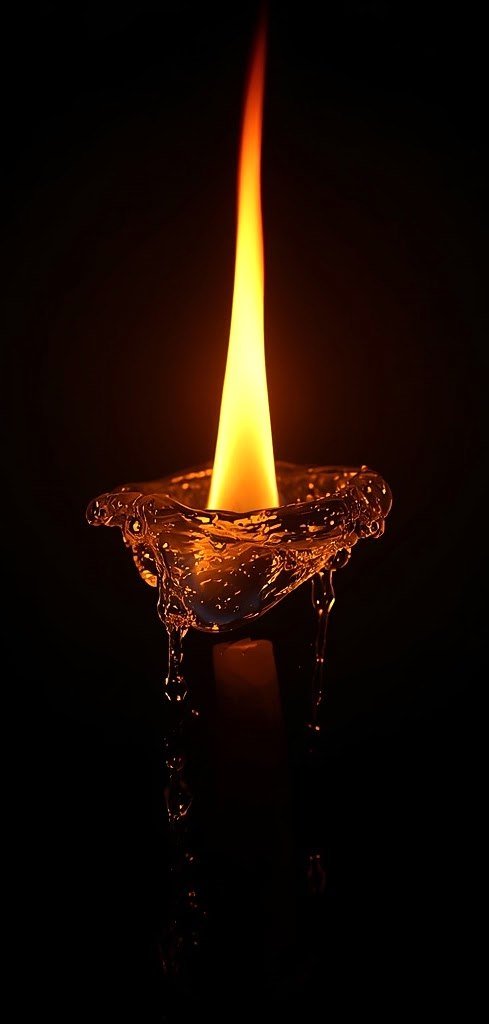
And there is the famous story: Rabia was seen walking through the streets of Basra carrying a torch in one hand and a bucket of water in the other. When asked what she was doing, she replied: “I am going to set fire to Paradise and pour water on Hell, so that both veils may be taken away, and people may worship God neither from fear of punishment nor desire for reward — but solely out of love.”
This shift — from fear to love as the organising principle of the spiritual path — was arguably the single most important development in the history of Sufi thought. Without Rabia, there would be no Rumi, no Hafiz, no Iraqi, no Yunus Emre, no whirling ceremony of the Mevlevi, no poetry of the ney’s longing. She did not merely contribute to the tradition of divine love. She made it possible.
From Hubb to Ishq: Love as the Ultimate Reality
In the early Sufi tradition, the language of love centred on hubb and mahabbah — presenting God as the Divine Beloved and the spiritual wayfarer as the lover. There remained a duality: the lover and the Beloved as two. But in the later Persian Sufi tradition, beginning especially with Ahmad al-Ghazali’s Sawanih (early 12th century), a radical shift occurred. The Sufis began to move from hubb to ishq — from love as relation to love as the ultimate reality itself.
In this vision, Ishq is not merely the feeling between lover and Beloved. It is the ground from which both the lover and the Beloved arise. Love is not something that happens between beings. It is the reality from which all beings emerge. Ahmad al-Ghazali wrote, with characteristic subtlety, that the root of love grows out of infinite pre-existence — that God’s love (yuhibbuhum) was cast as a seed from which humanity’s love (yuhibbunahu) grew. The seed was planted before the garden existed.
Rumi, inheriting and transforming this tradition, took it to its furthest reach. In the Mathnawi, he declared: “Love is the astrolabe of God’s mysteries.” An astrolabe is an instrument for navigating by the stars — for finding one’s position in relation to what is above. Rumi was saying that love is the only instrument capable of measuring the depths of the Divine. Not reason. Not theology. Not philosophy. Only love. And when the pen came to write about love, Rumi tells us, it broke. Some realities exceed the instrument of language. Love is the one reality that explains everything else — and that cannot itself be explained.

The Hidden Treasure
Beneath every Sufi teaching on love lies a tradition that has shaped the entire architecture of Islamic mysticism. Known as the Hadith of the Hidden Treasure, it is widely cherished across the Sufi tradition, though hadith scholars note that it lacks an authenticated chain of narration:
“I was a Hidden Treasure, and I loved to be known,
so I created creation, that I might be known.”
In this vision, existence itself is an act of love. The universe was not created out of necessity, out of boredom, out of surplus power. It was created because the Hidden Treasure — the absolute, unmanifest Real — desired to be known. And the instrument of that desire was love. Creation is love’s gesture. The cosmos is love’s body. Every form that exists is a face in which the Hidden Treasure becomes visible to itself.
This means that Ishq is not something the human being invented or initiated. It is the original condition of existence. The Beloved yearned for the lover before the lover knew there was a Beloved to yearn for. The universe is the space of that mutual longing — the place where the Hidden Treasure consents to be found.

The Two Faces of Love
The Sufi tradition recognises two faces of Ishq — two registers through which love moves, one leading to the other like the flower leads to the fruit.
Ishq-e Majazi
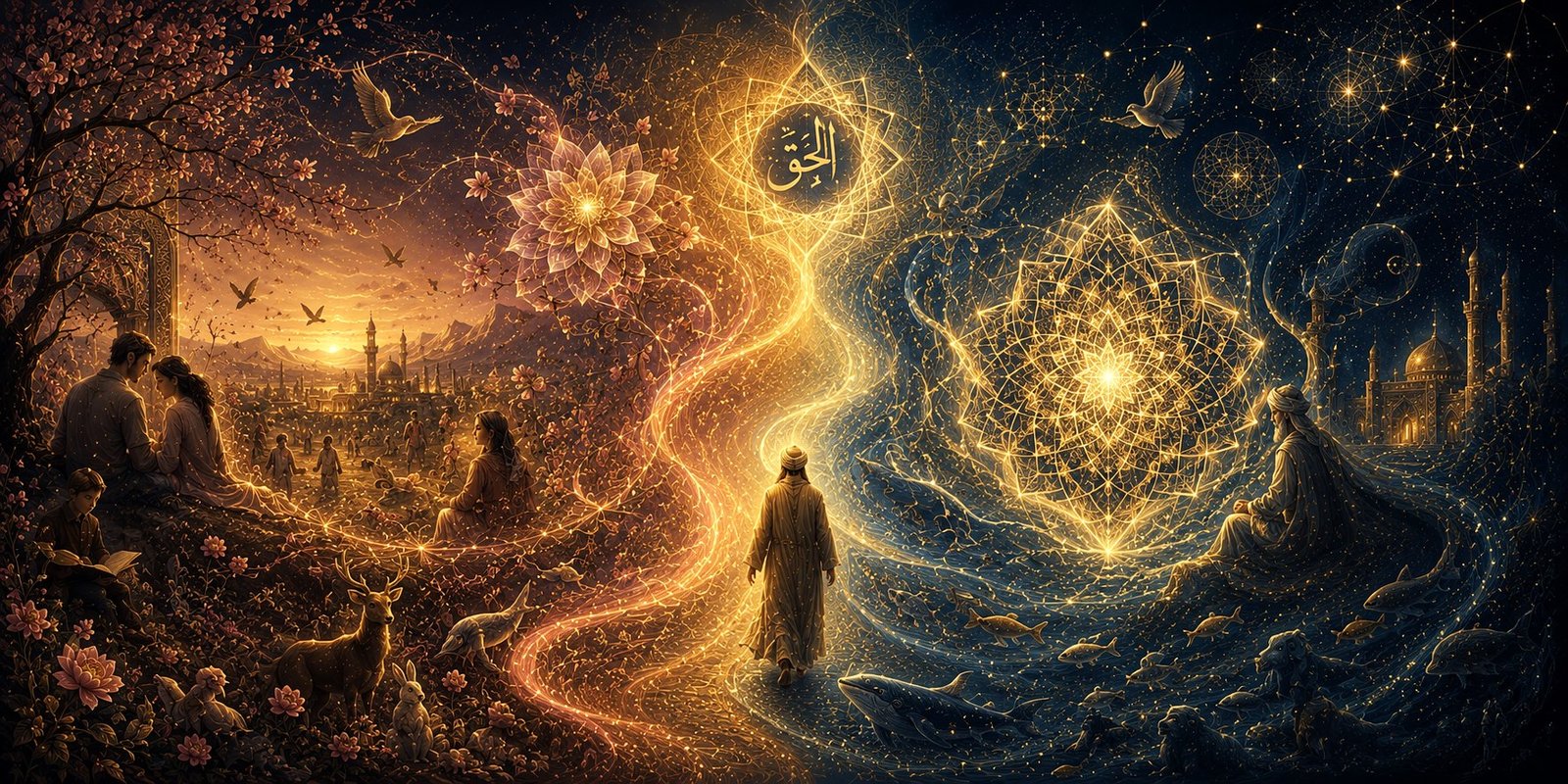
This is metaphorical love, the flower. This is love directed toward creation: love between human beings, love for beauty, love for the world in its radiance and its sorrow. The tradition does not dismiss this love. It honours it as a doorway. Sultan Bahu said that Ishq-e Majazi is the flower and Ishq-e Haqiqi is its fruit. The beauty of a face, the ache of longing, the tenderness between souls — these are not distractions from the Real. They are the first stirrings of a recognition that will, if followed faithfully, lead beyond itself. Majazi love is the alphabet in which the heart first learns to read; the grammar of the Divine is written in the same script.
Ishq-e Haqiqi
This is true, divine love. This is Ishq in its fullest intensity: the love of the Real (al-Haqq) for the Real. It encompasses every form of love that is directed toward the Divine — including the seeker’s love for the murshid (spiritual guide), which, as Wasif Ali Wasif understood, is not a separate category but a dimension of Ishq-e Haqiqi itself, since the murshid is loved not for his own sake but as a mirror of the Divine light. Here, the distinction between lover and Beloved collapses — not because it never existed, but because love has consumed the space between them. What Rabia prayed for — love for God’s own sake, without any veil of self-interest — finds its perfection here. And it is here that Ishq reveals its deepest secret: that it was never the human being who was doing the loving. It was always God, loving Himself through the vessel of the human heart. Yuhibbuhum wa yuhibbunahu. He loved them first.
Love as Ethical Force
Ishq is not only metaphysical. It is deeply, urgently ethical.
In Sufi practice, love is inseparable from adab — the discipline of right conduct, courtesy, and attentiveness that governs how one moves through the world. To love the Divine is to recognise the Divine in every encounter, every being, every moment of relation. This recognition transforms action: it demands gentleness where power is possible, patience where haste is tempting, and presence where distraction is easy.
Rumi saw everything in existence as continually revealing the Beauty, Generosity, Intelligence, Grace, and Love of the Divine Being. If this is true — if the universe is, as he experienced it, drenched in love — then carelessness toward any part of creation is not merely an ethical failing. It is a failure of perception. The one who truly sees cannot act without care, because care is the natural response to seeing the Beloved in all things.
The tradition teaches that love and inner knowledge (ma’rifah) are inseparable. Love is dependent on knowledge and knowledge is dependent on love. On the surface this seems contradictory. But in the lived experience of the path, it is not: to love deeply is to know; to know truly is to love. Knowledge without love is dry. Love without knowledge is blind. Together, they form the complete orientation of the heart toward the Real.

Love Beyond the Human Subject
Here, a charged and generative encounter opens between the Sufi understanding of Ishq and the concerns of contemporary posthuman thought.
Philosophical posthumanism, as Francesca Ferrando articulates it, is fundamentally concerned with decentering the human subject — with overcoming anthropocentrism, confrontational dualisms, and the hierarchical legacies of Western humanism. It asks: what forms of agency, care, and connection become visible when we stop placing the autonomous human individual at the centre of all relations? Ferrando envisions a post-anthropocentric praxis in which the human is understood as “plural and relational,” situated within webs of entanglement that include the nonhuman, the technological, and the ecological. Rosi Braidotti calls this a “transversal” subjectivity — constituted across multiple axes, embedded, embodied, and relational.
Ishq has always already answered this question — but from an entirely different direction.
In the Sufi understanding, love was never centred on the human subject to begin with. The human being is not the origin of love but its vessel, its instrument, its site of passage. Love flows through the human — between the Divine and creation, between the seen and the unseen, between beings who share in the condition of being loved into existence. God loved first. The human is not the author of this love. The human is authored by it.
The resonance with posthumanism is immediate. Both traditions decenter the human subject. Both refuse the fantasy of the autonomous individual as the master of meaning. Both insist that what matters most — love, agency, creativity — flows through us rather than originating in us. Ferrando’s insight that “we are all co-creators in the existential unfolding” resonates with the Sufi understanding that human existence is a co-creation between the Divine and the human heart — that we are instruments through which the Hidden Treasure becomes known.
And yet the divergence is as real as the resonance.

The direction of decentering
Posthumanism distributes agency horizontally — across human, nonhuman, technological, and ecological networks. Sufi love distributes it vertically — from the Divine through all levels of existence. In Ishq, the decentering of the self is not a philosophical move toward flatness. It is a movement of return — an ascent through love toward the Source of all love.
The ground of relation
Posthuman relationality is grounded in the immanent entanglements of matter, ecology, and technology. Sufi love is grounded in the Divine — in a vertical orientation that gives every horizontal relation its depth and its meaning. For the Sufi, the reason we can love the stranger, the sparrow, the stone is not merely that we are entangled with them in a material web. It is that the same Hidden Treasure shines through all of them.
Love as worship
Posthuman ethics speaks of care, response-ability, and attentiveness — vital and necessary formulations. Sufi Ishq speaks of all these things as worship. Every act of gentleness participates in the divine love that sustains existence. To care for another being is not merely to be ethical — it is to echo the original gesture of creation itself. In this vision, ethics and devotion are not two domains. They are one breath.
This project does not resolve this difference. It holds it as a space to inhabit — a space where both traditions can speak, and where the visitor is invited to listen to what emerges between them.
What Ishq Opens
If love is the ground of existence rather than a human achievement, then certain familiar assumptions begin to tremble.
The boundary between self and other becomes porous — not because identity is an illusion, but because love reveals a deeper unity beneath the surface of separation. The vine does not erase the tree; it embraces it until the two are one living form.
The distinction between sacred and ordinary becomes transparent — not through secularisation, but through the recognition that everything participates in the movement of divine love, whether it knows it or not. The marketplace is as holy as the prayer niche. The stranger’s face carries a divine name.
The opposition between knowledge and experience softens — because in Ishq, to truly know something is to be transformed by it. Knowledge without transformation is not yet knowledge. Love without knowledge is not yet love.
And the hierarchy between human and nonhuman shifts — not because humans are “just another species,” but because every being is a manifestation of the same love, the same desire to be known, the same overflowing of the Hidden Treasure into form.
Sitting with the Question
Relational Horizons does not seek to explain Ishq. When the pen came to write about love, Rumi tells us, it broke. But we invite you to sit, for a while, with these questions:
What would it mean to understand love
not as something you feel, but as something that moves through you?
What shifts in your sense of self
when love is not yours to possess but a current you participate in?
What forms of care, attention, and responsibility emerge
when every being is understood as a site of divine love?
And what does it mean that He loved them first —
that the love you feel for the Real
is already the Real’s love for you, returning home?

Contribute
If Ishq stirs something in you — a memory, an image, a question, a silence that feels more honest than speech — you are invited to share it. This gallery grows through the offerings of those who approach it with care.
Your contribution does not need to be finished, polished, or certain. In the tradition of love, the broken and the incomplete have always been closer to the truth. The vine does not wait until it is perfect to begin reaching for the light.
→ Visit the Participate page to contribute.