
إحسان
Ihsan
(Excellence in Consciousness and Action)

As If You See Him
When the angel Jibreel (peace be upon him), disguised as a man in white, came and sat before the Prophet Muhammad (peace be upon him) and asked, “What is Ihsan?” the Prophet answered with words that hold, in two brief sentences, an entire programme of spiritual life:
“It is to worship Allah as if you see Him.
And if you do not see Him, know that He sees you.”
(Sahih Muslim 8; Sahih al-Bukhari 50)
Two sentences. And within them, the entirety of what it means to live with full consciousness, full presence, full care. The first sentence describes the station of mushahada — direct witnessing, where the heart sees God in everything it turns toward. The second describes muraqaba — divine watchfulness, the awareness that even when your seeing fails, you are always, already, seen.
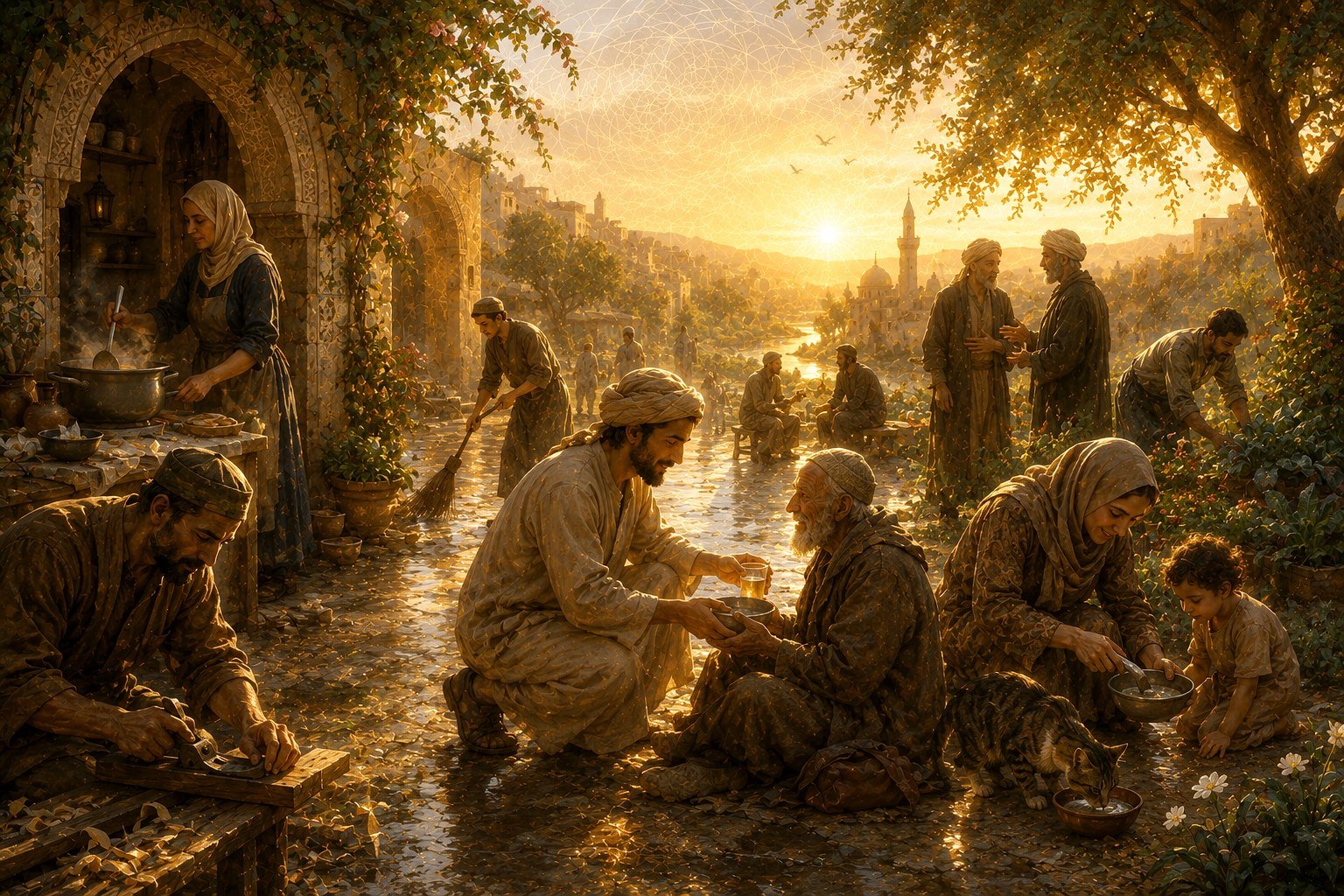
Together, they describe a way of being in the world where nothing is casual, nothing is careless, nothing is done in the absence of the Sacred — because there is no such absence. The hands that feed a stranger carry the same attentiveness as the hands raised in prayer. The conversation held with patience carries the same beauty as the verse recited at dawn. Ihsan does not divide the world into sacred and profane. It insists that every act, every encounter, every breath can be performed with a quality of presence so refined that it becomes, in itself, an act of worship.
This is Ihsan: excellence not as performance, but as presence. Not as achievement, but as attunement.
What Ihsan Means
The word Ihsan (إحسان) comes from the Arabic root h-s-n, which carries meanings of beauty, goodness, and doing something in the best possible way. To act with Ihsan is not simply to act correctly — it is to act beautifully. It is to bring to every deed a quality of care, sincerity, and completeness that transforms the ordinary into something luminous.
In the famous Hadith of Jibreel, Ihsan is presented as the third and highest dimension of the Islamic way of life, after Islam (outward submission and practice) and Iman (inner faith and conviction). If Islam is the body and Iman is the heart, then Ihsan is the spirit — the quality of consciousness that breathes life into both. Without it, prayer becomes mechanical. Without it, faith becomes abstract. Without it, even the most scrupulous adherence to the outer forms remains incomplete.
The Quran speaks of Ihsan not as an optional refinement but as a divine command. In Surah an-Nahl, Allah says: “Indeed, Allah commands justice (‘adl) and Ihsan, and giving to relatives, and He forbids immorality, wrongdoing, and oppression” (16:90). Here, Ihsan stands alongside justice — but beyond it. Justice (‘adl) gives each thing its due; Ihsan gives more than what is due. Justice is the floor. Ihsan is the sky.
And in Surah ar-Rahman, the question is posed with breathtaking simplicity: “Is the reward of Ihsan anything but Ihsan?” (55:60). Goodness returns to the one who does good — not as transaction, but as the nature of a reality in which beauty, once released into the world, comes home.
The Inner Dimension: Seeing with the Heart
Ihsan, at its deepest level, is not about what you do but about how you see. It is a transformation of perception before it is a transformation of action. When the Prophet (peace be upon him) said “as if you see Him,” he was describing a state of consciousness in which the awareness of God saturates every moment — not as a thought held in the mind, but as a seeing of the heart, a knowing so intimate that it colours the entire field of experience.
This is why many scholars describe Ihsan as the inner dimension of Islam — the place where the outward form of worship meets the inward reality of God-consciousness (taqwa). It is what transforms a ritual from routine into encounter, what transforms a good deed from obligation into devotion, what transforms an ordinary moment into a site of Divine recognition.
In the Sufi tradition, the cultivation of Ihsan is inseparable from the practices of remembrance (dhikr), watchfulness (muraqaba), and the gradual refinement of the ego (tazkiyah al-nafs). The one who practises Ihsan does not become excellent overnight. They become excellent through the slow, patient, often invisible work of returning the heart, again and again, to the awareness of God — until that awareness is no longer an effort but a condition, no longer something they do but something they are.
When someone lives in a state of Ihsan, as one writer has beautifully expressed, they “see the creation as nothing but a reflection of the Creator.” Every face becomes a theophany. Every encounter becomes a chance to serve. Every moment becomes a place where the Real can be recognised, honoured, and loved. Ihsan, in this sense, is the ethical fruit of Wahdat ul Wajood — the lived consequence of seeing unity in all things.

The Outer Dimension: Beauty in Every Deed
But Ihsan is not only an inner state. It radiates outward into the world through action.
The Prophet Muhammad (peace be upon him) said: “Verily, Allah has prescribed Ihsan in all things” (Sahih Muslim 1955). In all things. Not only in prayer and worship, but in how you speak to a neighbour, how you handle a disagreement, how you treat an animal, how you prepare food, how you work, how you grieve. Ihsan is the demand that excellence — beauty, care, completeness — be brought to everything you do. It is not reserved for sacred moments. It makes every moment sacred.
The Quran describes three gradations of doing good (16:90). The first is justice: doing good in return for good. This is the most basic level, accessible to anyone. The second is benevolence: taking the initiative in doing good, out of generosity, without waiting for reciprocation. This is higher, but still carries within it a subtle consciousness of the self as giver. The third — the level of Ihsan — is likened to the love between kindred: doing good as naturally and selflessly as a mother cares for her child. At this level, there is no thought of return, no residue of self-congratulation, no trace of the ego claiming credit. The good flows as water flows — because it is in its nature to flow.
This is why the Quran calls those who practise Ihsan muhsineen — and declares, repeatedly, that “Allah loves the muhsineen” (2:195, 3:134, 3:148, 5:93). The ones who do beautiful things are not merely obeying a command. They are participating in the Divine nature itself — for God, as the hadith tells us, is Beautiful and loves beauty.
Where Ihsan Meets the Other Concepts
Ihsan does not stand alone. It is the living expression of everything else in this gallery.
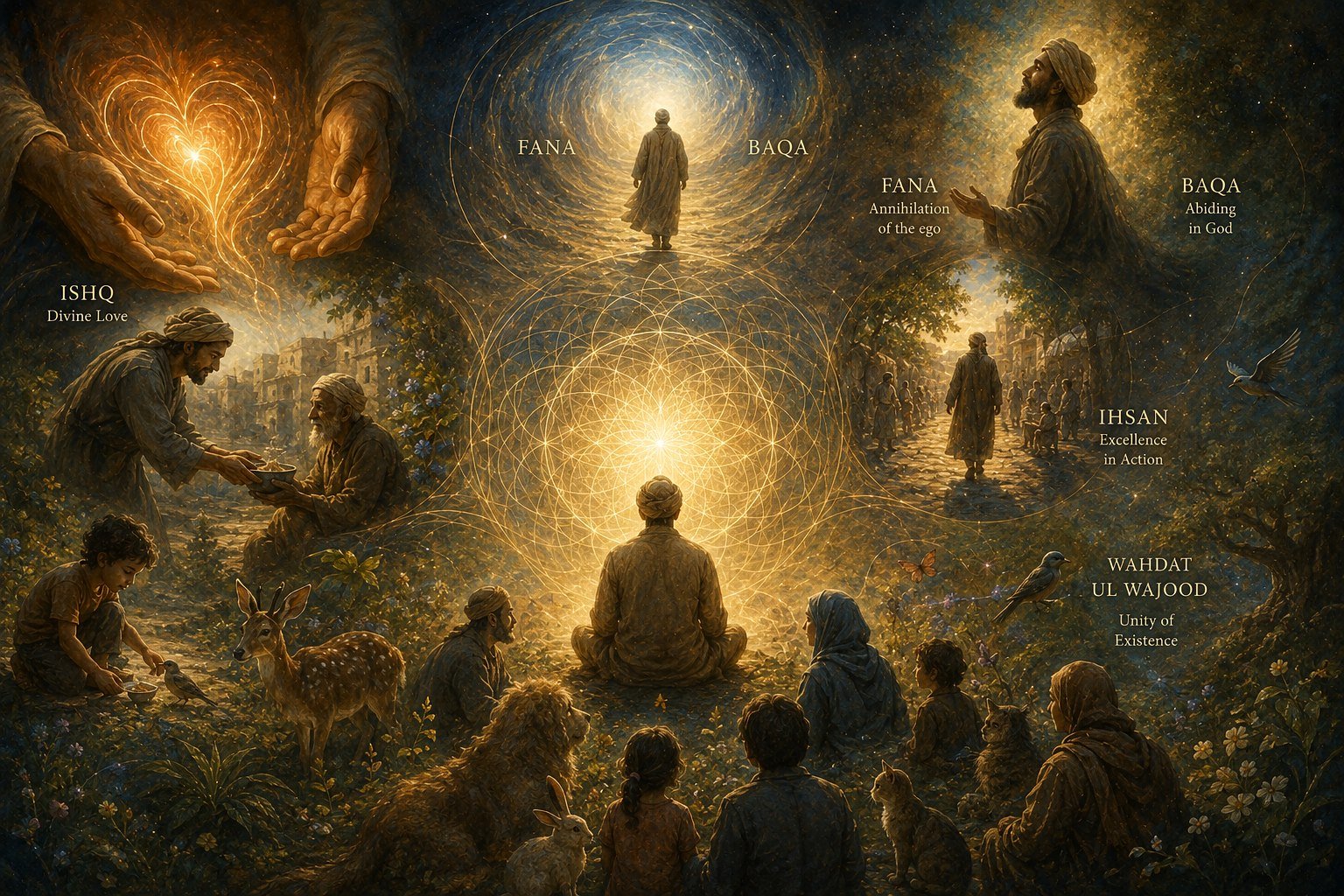
Ihsan is what Ishq (Divine Love) looks like when it moves through a human being’s hands. Love, when it is real, does not remain abstract. It manifests as care, as gentleness, as the refusal to act carelessly when attentiveness is possible.
Ihsan is what becomes possible after Fana and Baqa — after the ego has been consumed and the self has returned to the world in the robes of honour. The one who abides in God (Baqa) acts with Ihsan naturally, because the self-interest that once distorted their actions has been annihilated. Their excellence is not effort — it is the overflow of a heart that has been emptied and refilled.
And Ihsan is the ethical consequence of seeing Wahdat ul Wajood — the Unity of Existence. If every being is a manifestation of the Real, then to act without care toward any being is to turn away from a face of God. Ihsan is the ethics that flows from the vision of unity: a quality of attentiveness so deep that it becomes impossible to treat anything — a person, a creature, a moment — as beneath one’s care.
Two Ethics of Attentiveness
Here, the dialogue between Ihsan and contemporary posthuman ethics reaches its most fertile ground — because both traditions are, at their core, concerned with the same question: what does it mean to act with care in a world of radical entanglement?
Posthuman ethics, particularly in the work of Donna Haraway, asks us to cultivate “response-ability” — the capacity to respond with attentiveness and accountability within entangled, more-than-human worlds. In Staying with the Trouble, Haraway insists that ethical life means refusing the comforts of distance and mastery, and instead learning to remain present to the complexity, the mess, the unresolvable entanglements of living and dying together on a damaged planet. For Haraway, ethics is not a set of principles applied from above — it is a practice of situated responsiveness, cultivated through intimate attention to the beings and relations one is always already embedded within.
Francesca Ferrando’s philosophical posthumanism pushes further toward a “post-dualistic, post-hierarchical praxis” — an ethics that refuses to privilege any one form of life over another, that attends to the nonhuman with the same seriousness as the human, and that recognises knowledge itself as embodied, situated, and partial. Karen Barad insists that recognising distributed agency does not diminish responsibility but increases it — “that much more attentiveness to existing power asymmetries.”
The resonance with Ihsan is immediate and deep. Both traditions demand attentiveness. Both refuse carelessness. Both insist that how one acts — the quality, the care, the presence brought to each encounter — matters as much as what one does. Both recognise that ethics is not a code to follow but a way of being present to the world.
And yet, the divergence is as significant as the resonance.

The ground of attentiveness
Posthuman response-ability is grounded in the immanent web of material, ecological, and social relations. Care arises from the recognition that one is entangled — that actions have consequences across human and nonhuman networks. Ihsan is grounded in the awareness of God. The muhsin does not act with care because they recognise entanglement in a theoretical sense; they act with care because they see God — or, failing that, they know that God sees them. The attentiveness is the same. The ground from which it arises is different.
The quality of the act
Posthuman ethics asks: is this action responsive? Is it accountable? Does it attend to power asymmetries? Ihsan asks a subtler question: is this action beautiful? Is it done with the completeness, the sincerity, the luminous care that would be fitting if God were watching — which, in the vision of Ihsan, He always is? Beauty, in the Ihsan tradition, is not ornament. It is the mark of an action that has been brought to its fullest expression — an action in which nothing has been withheld, nothing has been done carelessly, nothing has been left incomplete.
Worship as ethics
For posthuman thought, ethics is relational and pragmatic — a matter of learning to live well in entangled worlds. For Ihsan, ethics is worship. Every act of care is an act of devotion. Every gesture of beauty participates in the Divine beauty that sustains existence. To feed a stranger is not merely to be ethical; it is to serve a face of God. To speak with patience is not merely good conduct; it is to echo the Divine attribute of gentleness. In Ihsan, the ethical and the spiritual are not two domains — they are one breath.
This project holds both ethical visions in dialogue — not to choose between them, but to ask what becomes visible when attentiveness is practised not only within the web of material relations, but within the gaze of the Divine. Both are needed. Both are urgent. And the space between them is where this gallery lives.
Excellence on a Damaged Planet
There is a question that presses itself upon any conversation about excellence in our current moment: what does Ihsan mean in a world marked by ecological crisis, technological disruption, social fragmentation, and the erosion of attention itself?
The Sufi tradition would answer: Ihsan has always been practised in difficult conditions. It is not a luxury of peaceful times. It is, if anything, more necessary when the world is broken — because it is precisely in brokenness that the quality of one’s attention, care, and presence matters most. A world that is accelerating needs the counterforce of ethical pacing. A world that reduces beings to resources needs the counterforce of seeing each being as a face of the Real. A world that fragments attention needs the counterforce of a consciousness that returns, again and again, to the Presence that underlies all things.
Haraway calls this “staying with the trouble.” The Sufi tradition calls it sabr — patience, steadfastness, the refusal to abandon attentiveness even when the world conspires to make you careless. The words are different. The ethical demand is remarkably close.

Sitting with the Question
Relational Horizons does not seek to explain Ihsan. Some forms of excellence can only be understood by practising them. But we invite you to sit with these questions:
What would it mean to bring the quality of worship
to every ordinary act of your day?
When was the last time you did something — anything —
with such fullness of attention that it became beautiful?
What changes in how you treat others
when you imagine that each encounter is witnessed by God?
And what would a world look like
in which excellence was not a competition to be won
but a quality of presence to be offered?

Contribute
If Ihsan stirs something in you — a memory of a moment when you acted with complete presence, an ache for a quality of attention you once had and lost, or a vision of what care could look like if it were practised without limit — you are invited to offer it to this space.
The offering need not be excellent in any worldly sense. In the tradition of Ihsan, what matters is not the polish but the sincerity — the willingness to bring to this gallery the same care you would bring to an act of prayer.
→ Visit the Participate page to contribute.