خودی
Khudi
(Selfhood and Self-realization)
The Seed That Carries Its Own Fragrance
There is a verse in the Quran that has haunted human reflection since it was first received:
“We offered the Trust to the heavens and the earth and the mountains,
but they declined to bear it and were afraid of it.
And the human being accepted it —
indeed, he was unjust and ignorant.”
(Quran, 33:72)
What was this Trust (amanah) that the mountains trembled before and the heavens refused? The tradition has understood it in many ways — as moral responsibility, as free will, as the burden of consciousness. But Allama Muhammad Iqbal, the poet-philosopher who gave the modern Islamic world one of its most powerful and contested ideas, read in it something else entirely: the trust of selfhood. The trust of personality. The divine gift of a self capable of knowing, choosing, creating, and standing before God not as a dissolved drop but as a formed and luminous being.
This is Khudi.
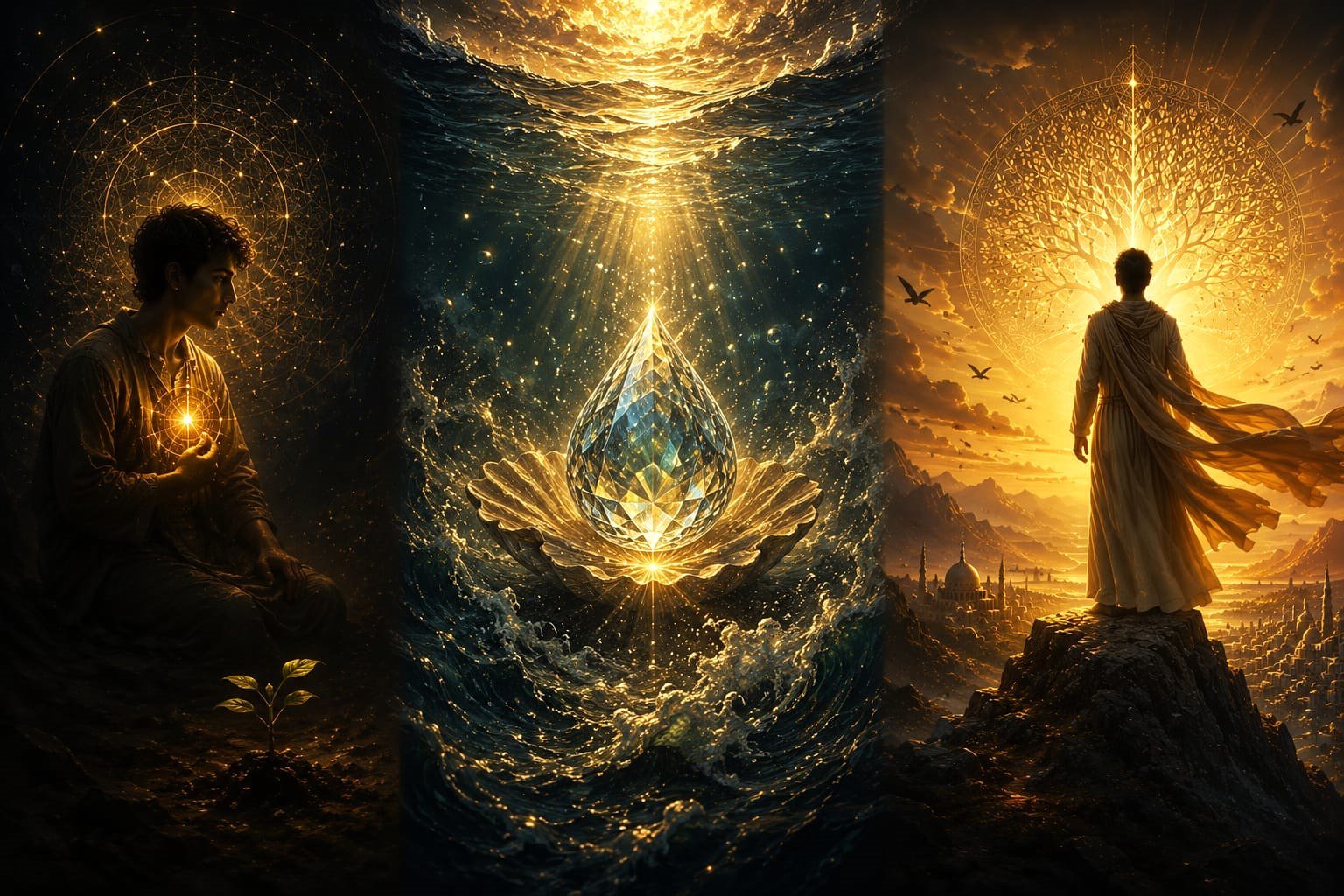
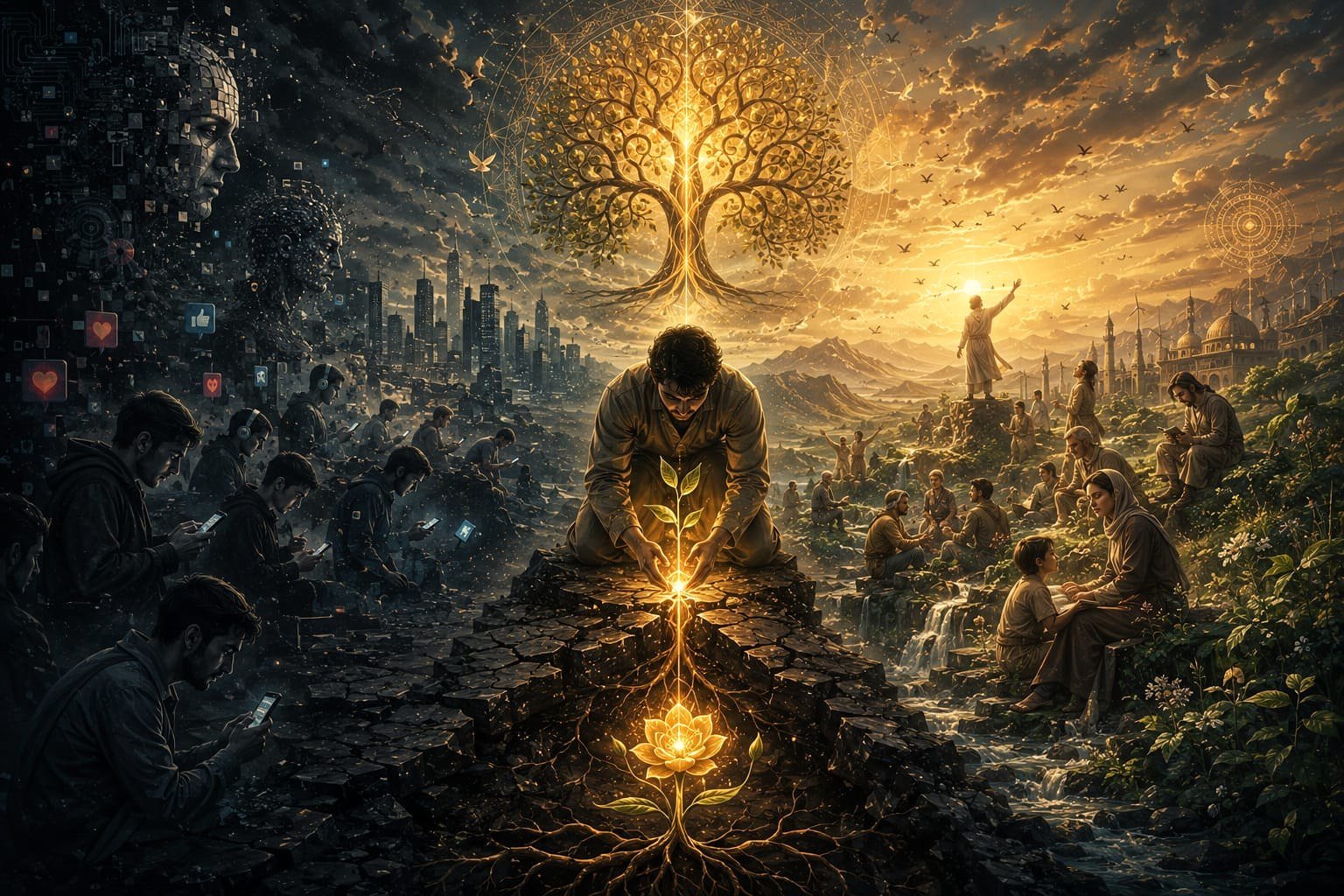
Not ego in the Western psychological sense. Not arrogance. Not the small self that clutches and hoards and insists on its own importance. Khudi is the divine spark (ruh) present in every human being — the spark for which, as the Quran tells us, God commanded the angels to prostrate before Adam. It is the capacity for self-awareness, for moral action, for creative agency, for the realisation of what one is called to become. But this capacity is not given as a finished gift. It is given as a seed. And the seed must undertake its own journey to reach the fragrance hidden within it.
What Iqbal Saw
Allama Muhammad Iqbal (1877–1938) published his Asrar-e-Khudi (Secrets of the Self) in 1915, and with it introduced a concept that would reshape the intellectual and spiritual landscape of the modern Muslim world. Written in Persian verse of extraordinary power, the Asrar is not merely a poem — it is a philosophical treatise sung in the language of fire, eagles, and oceans.
Iqbal wrote from within a specific historical moment: the Muslim world under colonial domination, its intellectual traditions in decline, its communities paralysed — in Iqbal’s diagnosis — by centuries of a mysticism that had taught them to regard the material world as illusion and self-annihilation as the highest spiritual goal. Whether or not this diagnosis was entirely fair to the Sufi tradition (and this gallery holds that question open), Iqbal’s response was revolutionary: he placed self-affirmation, rather than self-negation, at the centre of spiritual life.
For Iqbal, Khudi is not a datum — it is an achievement. It has the quality of growth and the quality of corruption. If the self does not take initiative, if it does not cultivate the inner richness of its being, if it ceases to feel the inward push of advancing life, then “the spirit within hardens into stone and is reduced to the level of dead matter.” But if the self rises — through discipline, through love, through creative action, through the assimilation of divine attributes into its own being — it approaches its destiny: to become God’s vicegerent on earth.
Iqbal drew his mandate directly from the Quran. God made the human being His khalifah — His representative (2:30). God taught Adam all the names (2:31). God breathed His spirit into the human form (15:29). And the Prophet (peace be upon him) said: “Takhallaqū bi-akhlāq Allāh” — “Create in yourselves the attributes of God.” For Iqbal, this was not a call to dissolve the self in the Divine. It was a call to become — to grow so fully into one’s God-given potential that the self becomes a mirror capable of reflecting, in its own unique way, the attributes of the One who created it.
The Journey of the Self
In the Asrar-e-Khudi, Iqbal traces the journey of Khudi through three stages of ascending realisation. Each stage requires the previous one; none can be bypassed.
Self-awareness
The first movement is the recognition of one’s own existence and potential. Before the self can grow, it must know itself — must become aware that it exists as a distinct centre of consciousness, capable of choice, action, and transformation. This awareness is not vanity. It is the first stirring of the divine spark recognising itself as divine spark. Without it, life is lived passively, reactively, as though one were merely a leaf blown by forces beyond one’s understanding. With it, the journey begins.
Self-discipline
The second stage is the hardening of the self through discipline, struggle, and the mastery of base desires. Iqbal uses the image of the diamond — “Be a diamond, not a dewdrop” — to express what is required. The dewdrop dissolves at the first touch of sunlight; the diamond endures, concentrates, becomes luminous through pressure. This is not asceticism for its own sake. It is the forging of a self strong enough to carry the weight of its divine vocation. The self must learn to resist what weakens it — conformity, passivity, the surrender of agency — and to embrace what strengthens it: love, courage, creative labour, and the discipline of aligning one’s will with the moral order of the universe.
Divine Vicegerency
The third and highest stage is the realisation of oneself as God’s vicegerent (nai’b) on earth. At this station, the self does not dissolve — it reaches its fullest individuality. As Iqbal wrote, the one who comes nearest to God is the most complete person. The fully developed Khudi does not vanish even when Reality is seen face to face. It stands before the Real, not as a drop returning to the ocean, but as a formed, luminous, God-reflecting being — what the tradition calls al-insan al-kamil, the Perfect Human. For Iqbal, the culminating point of selfhood is to cultivate the attributes of God within the self — not to become God, but to become the truest possible mirror of the Divine.

A Tension Within the Gallery
And here, something extraordinary happens. Khudi introduces a tension within this very project — a tension that Relational Horizons does not seek to resolve but to hold open, because holding it open is more honest than flattening it.
The earlier pages of this gallery have spoken with deep reverence of Fana — the annihilation of the ego in the Divine. We traced the stages of dissolution. We honoured the path of Hallaj and the sober wisdom of Junayd. We described the moth consumed in the flame as the perfection of love. And all of this was true — true to the classical Sufi tradition, true to the lived experience of those who have walked that path.
Iqbal saw it differently. He respected the Sufi tradition’s emphasis on spiritual experience. But he believed that the emphasis on self-negation had, over centuries, drained the Muslim world of its vitality, its agency, its creative power. He argued: if God created human beings as distinct persons, breathed His spirit into them, and placed them on earth as His vicegerents — why would the goal of the spiritual life be to dissolve that gift? Why would God create individuality only to demand its annihilation?
For Iqbal, the true interpretation of Hallaj’s “Ana al-Haqq” was “not the drop slipping into the sea, but the realisation and bold affirmation in an undying phase of the reality and permanence of the human ego in a profounder personality.” Hallaj was not losing himself. He was finding himself — finding the self that was always already the Creative Truth, not by disappearing but by standing forth.
Yet Iqbal himself acknowledged the complexity. Scholars have noted that despite his public critique of Fana, Iqbal confessed a “natural disposition” toward the very Sufism he defined himself against — that he was “constrained by the needs of the time” to emphasise self-affirmation over self-negation. And critically, Iqbal did not reject all forms of Fana. He reinterpreted it: Fana, properly understood, is not the annihilation of Khudi but the annihilation of base human attributes and their substitution by divine ones (takhalluq bi-akhlaq Allah). In this reading, Fana and Khudi are not opposites — they are two descriptions of the same transformation: the self shedding what is false in order to become what it truly is.
This gallery holds both voices. The classical Sufi vision of Fana, in which the self dissolves into the Beloved and discovers that it was never separate. And Iqbal’s vision of Khudi, in which the self rises, strengthens, and becomes the most luminous possible mirror of the Divine. These are not contradictions to be resolved by choosing one over the other. They are two melodies in the same devotional music — one singing of surrender, the other of becoming; one of the ocean, the other of the pearl that forms within it.
The Self After the Self Has Been Decentered
Khudi enters the dialogue with posthumanism at the most urgent possible point: what happens to the self after the self has been undone?
Contemporary posthumanism has powerfully critiqued the autonomous, self-governing individual of Enlightenment humanism. Rosi Braidotti, Francesca Ferrando, Donna Haraway, and others have shown that this subject was never universal — it was male, white, European, able-bodied, and constructed through the exclusion of everything deemed “other.” Decentering this subject was necessary and long overdue.
But decentering creates its own question: after the autonomous individual is undone, who remains to act? Who takes responsibility? Who creates? Who stands before injustice and says no? Braidotti herself acknowledges this tension, writing that posthuman ethics and politics “need to retain the idea of political subjectivity” — an agency capable of constructing new forms of ethical community. The posthuman subject, for Braidotti, is not erased but reconstituted — no longer the classical self-legislating subject of Kantian humanism, but a “vital, polyvalent connection-maker constituted in and by multiplicity.” Ferrando similarly calls for “an integral redefinition of the notion of the human,” not its abandonment.
Iqbal’s Khudi speaks directly to this question — from a tradition a century older than the posthuman turn, and from an entirely different ground.
Against Passive Dissolution
Both Iqbal and posthumanism reject a certain kind of selfhood — the arrogant, masterful ego that claims sovereignty over nature and others. But where posthumanism tends to dissolve this self into its relations, Iqbal insists on a self that rises through its relations. Khudi is not the liberal individual. It is not the autonomous subject of humanism. But it is not nothing, either. It is a self forged through discipline, refined through love, oriented toward God, and capable of action in the world. Iqbal would say to posthumanism: decentering is necessary, but dissolution is not the only option. There is also becoming.
Relational, not isolated
Khudi is not selfhood in isolation. Iqbal’s conception of the self’s growth moves through three levels: the intrapersonal (self-awareness), the interpersonal (relationship with others), and the transpersonal (relationship with God). The self becomes itself through relation — not apart from it. This resonates with Ferrando’s posthuman insistence on the relational, situated, and embodied nature of subjectivity. But it adds a dimension that posthumanism does not hold: the vertical relation to the Divine as the ground of selfhood. For Iqbal, you do not become yourself by mapping your entanglements. You become yourself by answering a call.
The vocation of the self
Posthumanism redistributes agency across human and nonhuman networks. Iqbal concentrates it. Not to deny the agency of the nonhuman, but to insist that the human being carries a specific vocation — the trust that the mountains refused and the heavens declined. This is not human supremacy in the Enlightenment sense. It is not the domination of nature. It is responsibility — the burden of being the one creature capable of reflecting all the divine names, and therefore the one creature most accountable for how it lives, what it creates, and what it destroys. Khudi does not place the human above creation. It places the human before God, bearing a weight that nothing else in creation was willing to carry.
This is Iqbal’s gift to the posthuman conversation: a vision of selfhood that is neither the arrogant ego that posthumanism rightly critiques, nor the dissolved node in a network that posthumanism sometimes settles for. It is a self that is disciplined, responsible, creative, God-oriented, and alive — alive with the urgency of one who knows that the trust has been accepted and the work is not yet done.
The Self in a Time of Dissolution
We live in a moment when the self is under pressure from every direction. Technology fragments attention. Social media performs identity rather than cultivating it. Economic systems reduce persons to consumers or data points. Ecological crisis reveals the limits of human mastery. And the philosophical decentering of the subject, however necessary, can leave individuals feeling unmoored — told that they are nodes in a network but given no map for how a node should live.
Iqbal’s Khudi speaks into this moment with startling directness. It says: the self is not an illusion to be debunked. It is a trust to be honoured. It is a seed that carries its own fragrance — but the seed must break open, push through darkness, fight against the elements, develop roots and branches and flowers, before the fragrance can be released. The journey is not optional. The fragrance will not emerge on its own. It requires the very things that our time conspires to make difficult: discipline, patience, creative struggle, and the refusal to accept passivity as a substitute for peace.
And yet — and this is where Iqbal’s Khudi meets the deepest currents of the Sufi tradition it critiques — the self that finally blooms does so not for its own sake. The fragrance is not for the flower. The vicegerent exists not for himself but for the trust he carries. The Perfect Human does not stand before God to be admired but to serve — to translate the divine will into history, to embody in time what is eternal, to carry the weight of creation’s care on shoulders that have been strengthened precisely for that purpose.
In the end, the highest form of Khudi is indistinguishable from the highest form of servanthood. The self becomes most fully itself at the exact moment it places itself entirely in the service of something greater. This is where Iqbal and the classical Sufis, despite all their disagreements, arrive at the same place: the self that matters is not the self that grasps. It is the self that gives.
Sitting with the Question
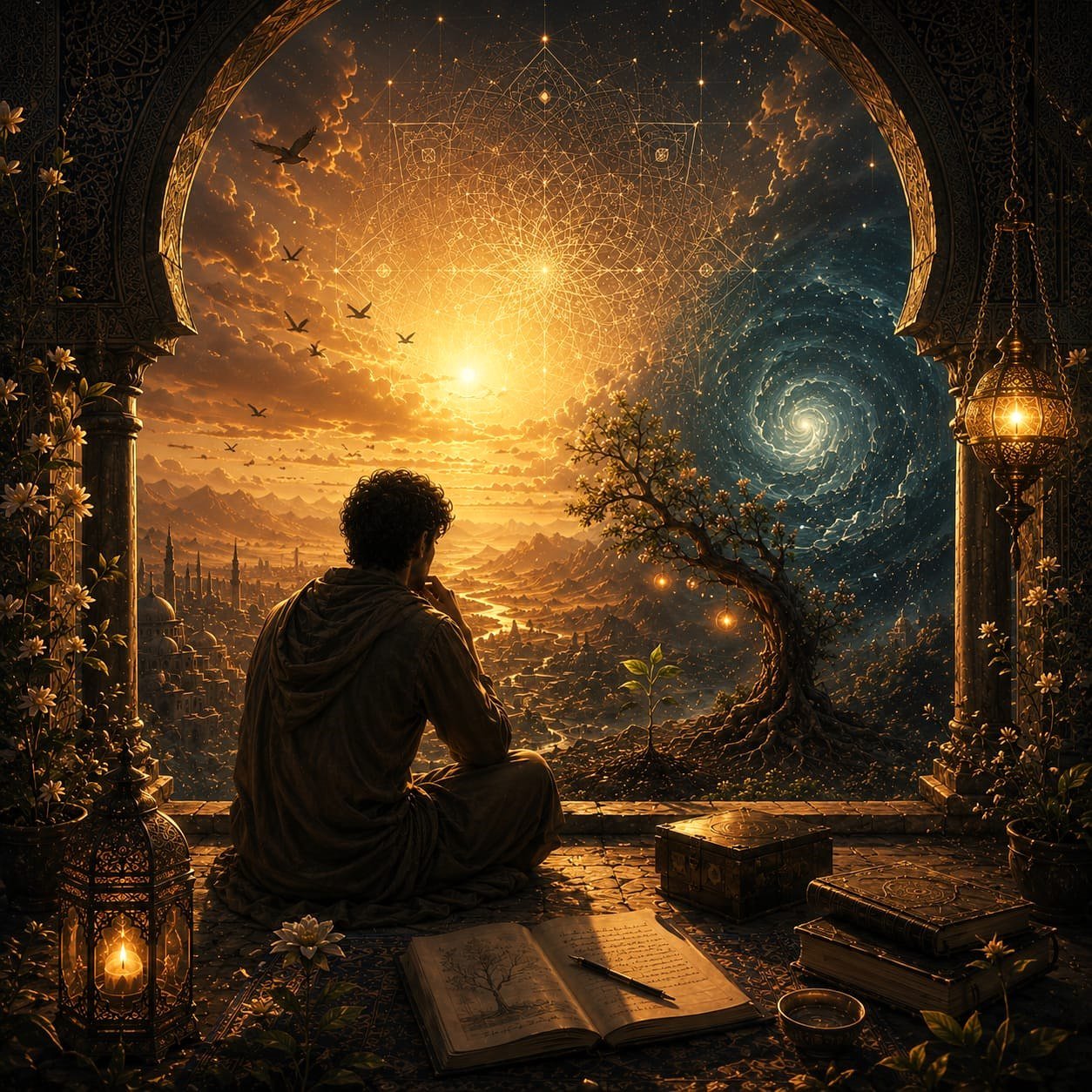
Relational Horizons does not seek to explain Khudi. Some seeds can only be understood by growing. But we invite you to sit with these questions:
What is the difference between the ego that grasps
and the self that rises?
What in you is seed — waiting, still,
for the struggle that will release its fragrance?
What would it mean to treat your selfhood not as something to defend
but as a trust to be honoured?
And how do you hold, in your own life,
the tension between surrender and becoming —
the ocean and the pearl?
Contribute
If Khudi stirs something in you — a recognition of your own unfinished becoming, a refusal to accept passivity, a sense that you carry something that the world has not yet seen — you are invited to offer it to this space.
What you bring may be a declaration or a doubt, a certainty or a question. In the tradition of Khudi, both are signs of a self that is alive — a self still in the act of becoming what it was created to be.
→ Visit the Participate page to contribute.