
فناء و بقاء
Fana & Baqa
(Annihilation and Abiding)

To Die Before You Die
Mutu qabla an tamutu
“Die before you die.”
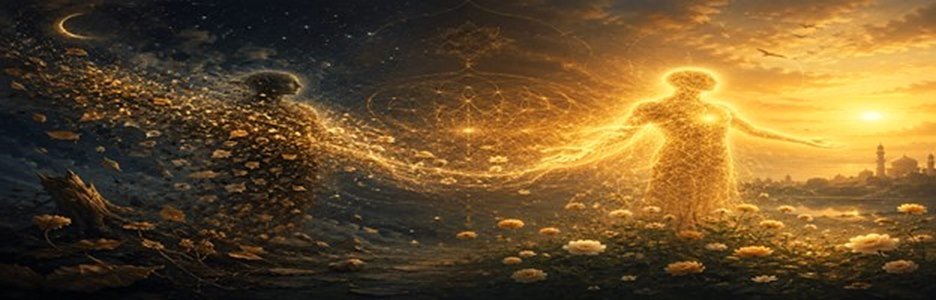
There is a death that comes to all things. The leaf knows it. The star knows it. The body, in its own quiet language, has always known it. But the Sufi tradition speaks of another death — one that is not waited for but walked toward. Not an ending imposed from without, but a surrender undertaken from within. A dissolution so complete that what remains is no longer the one who dissolved, but the Presence that was always already there, hidden behind the thin curtain of the self.
This is Fana — the passing away of the false. And what rises in its wake — luminous, unhurried, intimate with all things — is Baqa: abiding in the Real.
They are not two stations on a map. They are two breaths of the same breathing. The exhale and the inhale of a single turning toward God. To speak of one without the other is to tell half the story of a flame, describing only the burning, never the light.
What Burns, What Remains
Fana (فَنَاء) is often translated as “annihilation” — and the word can frighten those who encounter it unprepared. But Fana is not destruction. It is not the negation of existence. It is, if anything, the most radical affirmation of what truly exists — an affirmation so total that everything which is not Real simply cannot stand in its presence.
What is annihilated in Fana is not the human being. It is the illusion of a separate, self-sufficient self — the nafs al-ammara, the commanding ego that whispers: I am the centre. I am the author. I am apart. When this whisper falls silent — not through suppression but through the overwhelming arrival of something infinitely greater — what remains is not emptiness. It is Everything, seen at last without the distortion of a self standing in the way.
Al-Hujwiri, in the Kashf al-Mahjub, offered a formulation of extraordinary clarity: “Annihilation means annihilation of all remembrance of other, and subsistence means subsistence of the remembrance of God.” The veil is not the world. The veil is forgetting. When forgetting is annihilated, what remains is remembrance — and remembrance, in the Sufi tradition, is not a mental act. It is a mode of being. It is the heart’s continuous turning toward the source of its own existence.
And this turning does not happen once. The tradition teaches that there are thousands of moments of fana along the path — each one a small death of ignorance, a small birth of light. Every time a layer of the false falls away, the seeker has tasted annihilation. Every moment of existence, for the one who is awake, is pregnant with its own particular dissolution.

The Three Movements of Dissolution
Within this ongoing unveiling, the tradition traces three great arcs of surrender — each one deeper, each one closer to the flame.
Fana fi Sheikh
Fana fi Sheikh is the dissolution in the spiritual guide. The journey begins, as all true journeys do, in the presence of another. The murid (seeker) does not begin by storming the gates of heaven. They begin by learning, in the nearness of one who has already been refined by the path, that the ego colours everything it touches. To place trust in the murshid is not to abandon discernment — it is to taste, for the first time, what it means to let the walls of the self become transparent. This is the first loosening. The first permission to be undone.
Fana fi Rasul (SAW)
Fana fi Rasul means dissolution in the Messenger (peace be upon him). Now the seeker’s gaze lifts from the personal to the universal. The Prophet (peace be upon him) is not merely a historical figure to be studied — he is the living mirror of a self utterly surrendered to the Divine will, a life that became so transparent to God that mercy flowed through it like light through clear water. To dissolve in the Rasul (SAW) is to align one’s entire being — not just one’s actions but one’s inner posture, one’s way of standing before existence — with this Prophetic perfection. It is devotion as transformation.
Fana fi Allah
Fana fi Allah is the dissolution in God. Here, language begins to tremble. The limited existence of the traveller is overpowered by the absolute existence of Allah. The seeker can no longer find the boundary between self and Real — not because the Real has shrunk to the size of the self, but because the self has been swallowed by an ocean it never knew it was swimming in.

It is from within this station that the great ecstatic utterances (shathiyat) arose — words that shook the world and cost lives. Bayazid Bastami, consumed by the Divine presence, cried out: “Subhani ma a’zama shani!” — “Glory be to me, how great is my majesty!” And Mansur al-Hallaj, from the same fathomless depth, uttered: “Ana al-Haqq” — “I am the Truth.”
These were not claims of personal divinity. They were the voice of the Real speaking through a vessel from which the self had been emptied. Al-Junayd, the great master of the sober school of Baghdad, understood this — and also understood the danger. Some truths, spoken openly, are heard as blasphemy by ears that have not been prepared.
Hallaj was executed in Baghdad in 922 CE. His death was itself a final fana — a last dissolving into the very Truth he could not stop speaking. His story reminds us that this path is not a metaphor. It is not an intellectual exercise. It is a fire. And fire does not ask permission to burn.
The Turning
And yet — at the very centre of the burning, something extraordinary happens. Something that annihilation alone cannot explain.
The Quran holds it in a single breath:
“All that is on earth will perish (fan),
yet still abides (yabqa) the Face of your Lord,
majestic, splendid.”
(55:26–27)
Everything passes. Everything. And what remains is not absence but Presence — the Face of the Lord, radiant, undiminished, having been there all along, beneath and within and beyond every form that arose and fell away.
This is the hinge. The moment where fana opens its eyes and discovers it has become baqa.
Rumi understood this with the clarity of one who had lived it: the death of the stone is simultaneously the birth of the ruby. The drop does not first disappear and then, after some interval, become the ocean. In the very act of vanishing, it realises it was never anything but the ocean. The dissolution and the revelation are one gesture.
Dhu’l-Nun al-Misri, one of the earliest Sufi masters, said of the one who has undergone fana: he “is as he was, when he was before he was.” Returned to the primordial state. Before the veils. Before the forgetting. Before the little “I” drew its anxious circle and called it a self.

Baqa: What Abides
Baqa (بَقَاء) — remaining, subsistence, perpetual existence. To live with Allah, through Allah, in Allah, and for Allah. Not as a belief held in the mind, but as a condition of being — the way water is wet, the way light is luminous. Not something achieved and then possessed, but something received and then inhabited.
The tradition calls it “the slave’s return to humanity in the robes of honour.”
Consider this image carefully. It is a return. The one who has been annihilated does not remain dissolved. They come back — to the world, to the body, to the marketplace, to the ordinary rhythms of human life. But they come back changed. The ego that once mediated every encounter is gone. What returns is a being whose every gesture, every glance, every act of care is sustained by and transparent to the Divine.
After Fana fi Allah, the tradition teaches, Allah either keeps His slave in the “Station of stations” — held permanently in the Divine presence — or sends him back to the world. And the reason for this sending back is breathtaking in its simplicity: to perfect the still imperfect ones. Baqa is not withdrawal into mystical bliss. It is the most engaged, most ethically demanding, most present way of being alive. The one who abides returns to serve — to guide, to teach, to love with a love that no longer has a self at its centre.
Now this person “sees Allah established in everything and at all times.” The world does not vanish in Baqa. It is transfigured. The same streets, the same faces, the same morning light — but seen, now, for what they always were: manifestations of a single Presence, endlessly unfolding, endlessly inviting recognition.
The knower, as the tradition says, “abides in Allah and yet goes out toward creation with love, generosity, honour, and dignity.” Baqa is the life that flows from a heart that has been emptied and refilled — emptied of self, refilled with God. It is not the end of the story. It is the beginning of a way of being in the world that the ego, with all its ambition, could never have imagined.

The Ethics of the Emptied Heart
Baqa carries an ethical weight that is inseparable from its spiritual reality. The one who returns does so in radical humility — attributing nothing to themselves, claiming no credit, no mastery, no ownership over the knowledge that moves through them. The tradition names this ‘ubudiyya — perfect servanthood. The paradox is luminous: the one who has been annihilated in the Absolute returns as the lowest of servants. Having been nothing before God, they now serve everything in creation as though serving God directly — because, in the perception of Baqa, there is no distance between the two.
This connects intimately to Ihsan (excellence in consciousness and action), which has its own space in this gallery. But it must be said here: Baqa is not a private mystical state. It is, at its deepest root, a way of being with others — a mode of ethical presence, care, and responsibility that the ego, with its self-interest and its fears, could never sustain.
Where Two Dissolutions Meet
Here, a charged and generative encounter opens between this Sufi arc and the concerns of contemporary posthuman thought.
Philosophical posthumanism, as Francesca Ferrando articulates it, is fundamentally “a post-humanism, a post-anthropocentrism, and a post-dualism” — an onto-epistemological approach dedicated to overcoming the hierarchical legacies of Western humanist thought. It does not merely critique the autonomous human subject; it asks what forms of existence, relation, and ethics become visible when the fantasy of the masterful, bounded self is set aside. Thinkers like Rosi Braidotti envision the posthuman subject as relational and transversal, constituted across multiple axes of embodiment and entanglement. N. Katherine Hayles speaks of “the end of a certain conception of the human” — the conception that served, at best, only those with the privilege to imagine themselves as autonomous agents.
The resonance with Fana is immediate and striking. Both traditions refuse the illusion of the self-sufficient subject. Both recognise that what we call “I” is far more porous, far more entangled, far less self-originating than the ego insists. Both suggest that clinging to the fiction of a separate, sovereign self is not only an intellectual error but an ethical danger — producing domination, extraction, and the refusal to recognise one’s embeddedness in a web of relations that exceeds human control.
And yet the divergence is as real as the resonance — and it is here, in the space of honest difference, that the dialogue becomes most alive.

The direction of undoing:
Posthumanism dissolves the self outward — into networks, assemblages, material entanglements, more-than-human ecologies. The autonomous subject disperses into a field of distributed agencies, each co-constituting the other. Fana dissolves the self inward and upward — into the Divine. The self is not scattered across a network; it is absorbed into the Absolute, consumed by the One from which all multiplicity arose. One is dispersal. The other is return to the Source. Both undo the bounded self. But the undoing moves in opposite directions — and what is found on the other side differs profoundly.
What comes after the undoing:
This is where Baqa sharpens the conversation. Posthumanism, having decentered the subject, asks: what ethics is possible without a sovereign self? Donna Haraway responds with “response-ability” — the cultivation of attentive, situated responsiveness within entangled worlds. Karen Barad insists that recognising nonhuman agency does not diminish human accountability but demands “that much more attentiveness to existing power asymmetries.” These are vital formulations. But Baqa offers something they do not hold: the dimension of return. In the Sufi arc, the undoing of the self is not the conclusion of the ethical story — it is the condition for a radically transformed re-entry into the world. The one who abides in God does not merely “respond” to a web of relations; they serve within it with a perception purified of self-interest, sustained by a love that is not their own.
Embodied practice, not theory alone
Posthuman decentering is, largely, a conceptual operation — it takes place in texts, seminars, and philosophical frameworks. Fana and Baqa are practices — achieved through disciplined remembrance (dhikr), purification of the ego (tazkiyah al-nafs), spiritual struggle (mujahadah), and the sustained guidance of one who has already walked the path. The body is involved. The breath is involved. The years of quiet, unglamorous inner work are involved. Here, the self is not merely reconceptualised. It is transformed.
The question of transcendence:
Ferrando’s philosophical posthumanism, like much contemporary critical thought, is committed to overcoming dualisms — including, implicitly, the dualism between immanent and transcendent. It gestures toward a post-dualistic, post-hierarchical praxis for sustainable futures. And yet the Sufi tradition operates within a vertical orientation toward the Divine that is irreducible to horizontal relation. In Fana, the self does not dissolve into “the world” understood as a flat plane of immanent relations. It dissolves into God. In Baqa, it returns to the world carrying the light of that encounter. The posthuman critique of hierarchy is essential and must be heard. But the Sufi path asks, with the gentleness of centuries: what if certain dimensions of existence — and therefore of ethics, of care, of responsibility — only become visible from within a vertical orientation? What if the refusal of transcendence, however well-intentioned, is itself a narrowing?
This project does not resolve this tension. It holds it open — as a space where both traditions can speak, genuinely and without reduction, and where the visitor is invited to listen to what emerges between them.
The Paradox at the Heart
Fana and Baqa hold a paradox that no philosophy can flatten, and that the tradition has never attempted to resolve.
The self must be dissolved — but the practice of dissolving requires a self to undertake it. Dhikr must be performed by someone before it annihilates the one performing it. The murid must walk the path in order to arrive at the place where the walker vanishes. And then, beyond vanishing, the walker must return — but as one who is no longer walking for themselves.
This is not a contradiction to be argued away. It is the living texture of the spiritual life. The self that enters Fana is not the self that emerges in Baqa. And yet, without entering, there is no emergence.
Perhaps this is what the tradition has always known: that the deepest truths are not propositions to be defended but thresholds to be crossed. That the explanation is the walking itself. That the only way to understand fire is to let it touch you.
And then — to return. With robes of honour. With love, generosity, and dignity. To serve.
Sitting with the Question
Relational Horizons does not seek to explain Fana and Baqa. Some thresholds can only be understood by crossing them. But we invite you to sit, for a while, with these questions:
What would it feel like to let go — not of something you have, but of someone you think you are?
Where in your life have you already tasted small annihilations —
moments where the edges of the self softened, and something larger breathed through you?
What is the difference between losing yourself and being found?
If the self that fears annihilation is itself the veil,
who is it that remains when the veil falls?
And what does it mean to return —
not as who you were, but as what love has made of you?

Contribute
If Fana and Baqa stir something in you — a recognition, a trembling, a question you cannot answer, or a silence that feels more honest than speech — you are invited to offer it to this space.
Not everything that matters can be spoken. In the tradition of annihilation and abiding, the truest offering is often the one that admits its own incompleteness — and trusts that what remains, after everything else has fallen away, is enough.
→ Visit the Participate page to contribute.